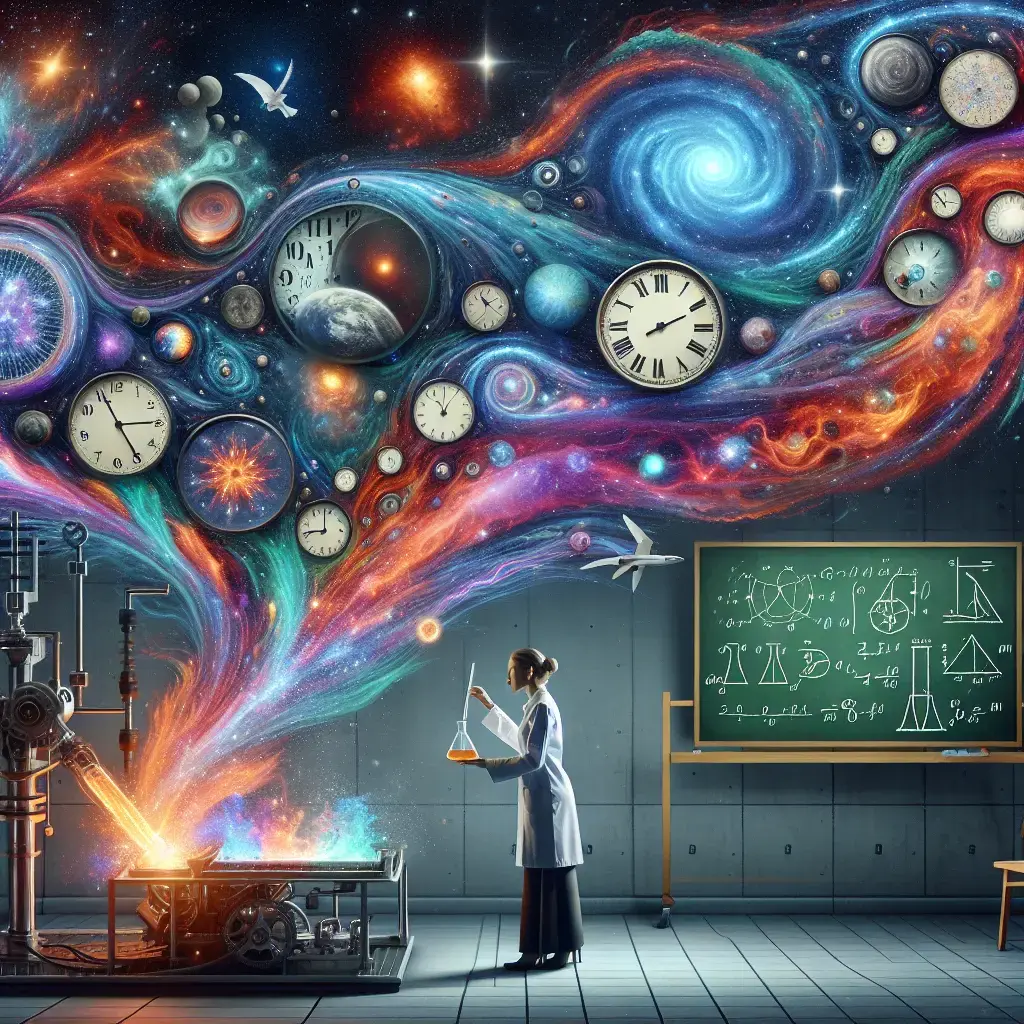
Quantum physics, with its perplexing principles and phenomena, continues to challenge our understanding of the universe, particularly when it comes to the very fabric of space and time.
The idea that space and time might adhere to quantum rules is an intriguing frontier in physics. Recent experimental proposals aim to explore whether spacetime itself can exist in a quantum superposition—essentially being in multiple states or "shapes" simultaneously. This potential breakthrough could address the glaring gap in our current physical theories: the absence of a quantum description of gravity.
The Quest for Quantum Gravity
Physicists have long sought to integrate quantum mechanics with general relativity to achieve a unified theory of quantum gravity. While quantum mechanics governs the behavior of particles on the smallest scales, general relativity describes the gravitational force in terms of curved spacetime on cosmic scales. The challenge lies in developing a framework that reconciles these seemingly incompatible theories.
Mind-Bending Experiments on the Horizon
Several proposed experiments seek to unveil the quantum nature of spacetime by investigating its possible superposition. These groundbreaking tests are designed to probe the minutiae of gravitational interactions at the quantum level.
Some of the proposed methods include:
Entangling particles with gravitational fields: By examining how particles entangled with gravitational influences behave, researchers hope to detect signs of spacetime's quantum properties.
Interferometry techniques: Using sophisticated equipment to measure tiny differences in the paths that light takes through a gravitational field, scientists aim to observe the effects of superposition on spacetime.
Implications for Our Understanding
Uncovering evidence that spacetime follows quantum rules could revolutionize our comprehension of the universe. It could lead to new insights into black holes, the origins of the cosmos, and even the fundamental nature of reality itself.
However, these experiments are not without their challenges. The scale at which these quantum effects manifest is incredibly small, requiring extraordinary precision and technological advancements. Nevertheless, the potential rewards—gaining a deeper understanding of the universe's most elusive aspects—are immense.
In conclusion, exploring whether space and time adhere to quantum rules is not just a theoretical pursuit but a tangible step toward unlocking some of the universe's most profound mysteries. As these pioneering experiments unfold, they may not only illuminate the nature of gravity but also transform our understanding of reality itself.
For those interested in diving deeper into this topic, I recommend checking out this article.
Thank you for joining this exploration into the fascinating world of quantum physics. May your curiosity lead you to new and exciting discoveries!
Author: Harper Collins